Heat Pump Installation in Aylestone, Leicester
MCS-certified air source heat pump installation across Aylestone's Victorian stock, the Conservation Area around St Andrew's Church, and the riverside neighbourhoods bordering Aylestone Meadows. £7,500 BUS grant supported.
Last reviewed: 21 May 2026
-
£7,500 BUS grant
available toward an MCS-certified heat pump installation in Aylestone. Statutory figure — gov.uk Boiler Upgrade Scheme.
-
MCS-certified installation
is required for the BUS grant and to protect manufacturer warranty terms. Every installer in our network is MCS-certified.
-
~3–4× the efficiency of a gas boiler
in typical UK conditions, measured by SCOP across a full heating season. Leicester's design winter temperature is around −3.6°C.
Heat pumps in Aylestone — the local context
Aylestone was documented in the Domesday Book as "Ailstone" (Anglo-Saxon "Aegel's settlement" or "Egil's settlement"), making it one of the oldest continuously-occupied areas in our Leicester coverage. The suburb was incorporated into the Borough of Leicester through the Leicester Extension Act 1891, which absorbed the historic village into the expanding city. Today the housing-stock pattern is mixed: roughly 40% Victorian (1870–1910), 30% interwar and early-20th-century (1920–1950) and 30% post-war/modern (1950 onwards). Recorded population of around 11,151 at the 2011 Census.
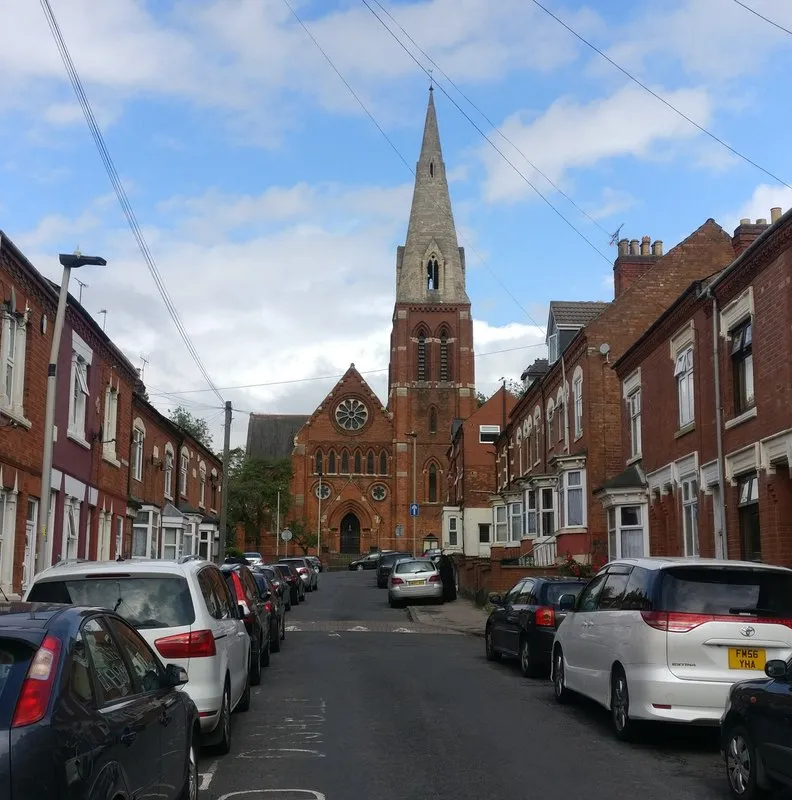
Aylestone is in Leicester City Council's planning jurisdiction. The Aylestone Village Conservation Area is on LCC's published register of 25 conservation areas. Check whether your address falls inside its boundary on the LCC planning portal before the heat pump survey. Inside the CA, external alterations on principal elevations need planning permission rather than relying on Permitted Development.
Aylestone carries an unusual concentration of significant listed-building heritage for a Leicester neighbourhood:
- St Andrew's Church — Grade II* listed, 13th-century tower and north aisle, built from Triassic sandstone with a distinctive broach spire. The church anchors the historic village core.
- Aylestone Hall — 14th-century timber framing, dendrochronologically dated to 1339. The dendro-dating is unusually precise heritage evidence and gives the hall an exact construction year that few medieval buildings carry.
- Packhorse Bridge — Grade II* AND a Scheduled Monument, the latter being a separate (and higher) heritage protection. Probably 15th-century, eleven small arches crossing the River Soar. Few Leicester area structures carry Scheduled Monument status.
These three structures span medieval to 15th-century history. Listed-building consent applies on the structures themselves and may apply on nearby properties on a case-by-case basis depending on visual relationship and curtilage. Properties immediately adjacent to St Andrew's Church and within the Aylestone Village CA carry the heaviest combined planning constraint; your installer engages Leicester City Council's conservation officer at the survey stage on properties in this footprint.
The Victorian housing stock (around 40% of Aylestone's total) is solid-wall construction predating any cavity-wall standard. R290 heat pumps (capable of flow temperatures up to 75°C) are the routine design choice, paired with a subset of radiator upgrades on the rooms with the largest exposed wall area. Solid-wall insulation is often part of the wider retrofit conversation — though BUS grants do not fund it, so fabric improvements are usually owner-funded or covered by Warm Homes funding for eligible households.
Interwar 1920s–1940s stock (around 30% of housing) is cavity-wall construction, the easier retrofit profile. Standard R32 monobloc heat pumps at 7–9 kW work well across this stock. Post-war and modern (around 30%) is similar in retrofit shape, with smaller plots in some of the post-1950 estate developments.
Aylestone Meadows Local Nature Reserve (designated 2003) provides semi-rural character on the city's south-western edge. It is one of the largest green spaces in Leicester. Properties bordering the Meadows benefit from the open outlook on one elevation, often giving more outdoor unit siting flexibility. The River Soar floodplain runs alongside the reserve, which means some properties near the river need to reference Flood Map for Planning when siting the outdoor unit base height. Manufacturer specifications for installations in flood-risk areas typically apply.
Off-gas-grid status is worth flagging on Aylestone's LE8 fringe. The main LE2 residential area has overwhelming mains-gas connection, but the south-eastern LE8 fringe of Aylestone — closer to the city boundary — may include some off-grid or LPG-serviced properties. Cadent, the gas network operator for the area, can confirm whether mains gas reaches a particular address. For confirmed off-grid properties currently on oil or LPG, the £9,000 grant rate (applications until 31 March 2027) is the relevant amount rather than the standard £7,500.
Beyond the residential streetscape, Aylestone carries other heritage layers: Grand Union Canal infrastructure (Sanvey Lane and Middle Street character reflect canal-industrial history), and a historic tram service that operated 1878–1947 — evidence of early 20th-century transport connectivity that drove some of the area's residential growth.
For an Aylestone heat pump installation, the practical sequence is: per-property planning check on the LCC portal including CA boundary verification, listed-building consent inquiries on properties within visual relationship to St Andrew's Church, Aylestone Hall, or Packhorse Bridge, Cadent verification on LE8 fringe properties, free survey, R290 or R32 monobloc heat pump sized to the building (typically 7–11 kW), three to five radiator upgrades on Victorian stock, two to four on interwar and later stock, MCS-certified installation under PD or CA planning depending on CA status, BUS grant (£7,500 or £9,000 depending on existing fuel) applied by the installer on the homeowner's behalf, and commissioning. Three to six days on site, plus the CA planning timeline where applicable.
Heat pump services for Aylestone
Terraced streets need a careful noise check; the historic core near St Andrew's Church calls for rear siting. Our service pages explain each stage, and an enquiry through this site goes to one local installer from our network.
Paying for a heat pump in Aylestone
If your household income is under £36,000 and your home is rated EPC D to G, Leicester City Council's Warm Homes: Local Grant may pay for a heat pump or insulation in full.
Otherwise, the Boiler Upgrade Scheme takes £7,500 off for any homeowner or private landlord, with no income test. Some properties on the edge of Aylestone aren't on Cadent's gas network. If you heat with oil or LPG, the grant is £9,000 on applications by 31 March 2027. Details on our costs and grants page.
Estimated cost in Aylestone
Aylestone heat pump installations typically run £8,500–£12,500 before the £7,500 BUS grant — net £1,000–£5,000 (or net £0–£3,500 for confirmed off-grid LE8 fringe properties on the £9,000 rate). The mixed Victorian / interwar / post-war stock — and the unusual concentration of heritage assets — produce a wider cost range than more homogeneous Leicester neighbourhoods.
Victorian stock (around 40% of housing, 1870–1910). Particularly those inside the Aylestone Village Conservation Area on the LCC register. £11,000–£12,500 gross. Solid-wall heat-loss profile, R290 heat pumps at the higher flow temperatures the period stock needs, three to five radiator upgrades (often including a bay-window radiator on the front reception), CA planning fees through LCC (usually under £250). Listed-building consent on properties within visual relationship to St Andrew's Church, Aylestone Hall, or the Packhorse Bridge adds further design complexity at the top of the range.
Interwar 1920s–1940s stock (around 30%). £9,500–£11,000 gross. Cavity-wall, R32 monobloc systems at 7–9 kW, two to four radiator upgrades.
Post-war and modern stock (around 30%). £8,500–£10,000 gross. Cavity-wall, R32 monobloc at 7–8 kW, often fewer radiator upgrades on the post-1980 portion where emitters were sized closer to heat-pump operating temperatures.
Floodplain and Flood Map for Planning. Properties on the LE8 fringe and the streets bordering the River Soar near Aylestone Meadows may need to reference the Flood Map for Planning when siting the outdoor unit base height. Manufacturer specifications for installations in flood-risk areas typically apply — this isn't a cost driver in most cases but can add a base-plinth or wall-mount item to the line items.
Heritage-asset-adjacency premium. Aylestone's three significant Grade II / II* heritage structures are the highest density in our Leicester coverage. Listed-building consent on adjacent properties takes its own LCC route and can push particular installations toward the top of the range with bespoke external-unit screening or reversible-fixings detail.
After grant, the typical net Aylestone installation sits £1,000–£5,000 (or £0–£3,500 at the £9,000 off-grid rate). Heat pump lifespan (15–20 years vs 10–15 for gas) and the gas-versus-electricity price trajectory close the gap further over the long run. Request a quote for a property-specific comparison; the 2026 heat pump cost guide breaks down the cost drivers.
Finding a good installer in Aylestone
Check the company on the MCS register: without certification there's no grant. Be wary of cold calls offering free heat pumps; genuine free schemes run through the council.
Planning questions for Aylestone go to Leicester City Council. See finding a trustworthy installer and how we select installers.
Heat pump installation in Aylestone — FAQ
How long does heat pump installation take in Aylestone?
Most installations take three to five days at your home, after the survey and quote. Homes on the southern fringe that use oil also need the tank removed.
Do I need planning permission for a heat pump in Aylestone?
It depends on whether the property sits inside the Aylestone Village Conservation Area. The CA is on Leicester City Council's published register of 25 conservation areas. Its exact boundary should be checked for your address on the LCC planning portal before the survey. Inside the CA, external alterations on principal elevations need planning permission rather than relying on Permitted Development. Outside the CA, standard PD applies: the 1.5 m³ outdoor unit threshold, the MCS 020(a) noise standard at 37 dB LAeq,5min at the nearest residential window, and standard siting clearances. Listed buildings always need listed-building consent regardless of PD.
Are heat pumps suitable for Aylestone's Victorian streets?
Yes — most Aylestone Victorian properties (around 40% of the area's housing stock, dating from roughly 1870–1910) are heat-pump-suitable with the right specification. Two design choices typically apply: an R290 heat pump (capable of higher flow temperatures up to 75°C) to work with the existing radiator sizing in solid-wall properties, and a subset of radiator upgrades on the rooms with the largest exposed wall area. The streets around St Andrew's Church and into the historic village core sit inside the Aylestone Village CA — design and siting work should reckon with the CA constraints early. The wider Victorian-era streets outside the CA boundary follow standard PD.
Am I eligible for the £7,500 BUS grant in Aylestone?
Most homeowners and private landlords are. The grant is £7,500 with no income test, or £9,000 if you heat with oil or LPG (applications by 31 March 2027). Lower-income households may qualify for free Warm Homes funding instead.
How much does heat pump installation cost in Aylestone?
Roughly £8,500–£12,500 before the grant and £1,000–£5,000 after it. Radiators, the cylinder and any microbore pipework make the biggest difference.
What heritage features should I know about in Aylestone?
Aylestone carries three significant listed-building assets — among the strongest heritage densities of any neighbourhood in our coverage. St Andrew's Church is Grade II* listed, with a 13th-century tower and north aisle, built from Triassic sandstone with a distinctive broach spire. Aylestone Hall has 14th-century timber framing, dendrochronologically dated to 1339 (the dendro-dating is unusually precise heritage evidence). The Packhorse Bridge over the River Soar is Grade II* AND a Scheduled Monument — probably 15th-century, with eleven small arches. These three structures span medieval to 15th-century history and make Aylestone one of the oldest continuously settled areas in our coverage. Listed-building consent applies on the structures themselves and on nearby properties on a case-by-case basis.
What about Aylestone Meadows nature reserve?
Aylestone Meadows is a Local Nature Reserve designated in 2003, providing semi-rural character on the city's south-western edge. It is one of the largest green spaces in Leicester. Properties bordering the Meadows benefit from the open outlook on one elevation, often giving more outdoor unit siting flexibility. There's no separate planning regime for property near the Meadows itself, but the River Soar floodplain runs alongside the reserve, which means some properties near the river need to reference Flood Map for Planning when siting the outdoor unit base height. Manufacturer specifications for installations in flood-risk areas usually apply.
Will I need new radiators with a heat pump in an Aylestone home?
Some, most likely. Victorian terraces need more radiator upgrades than the interwar and post-war homes. Larger radiators let the heat pump run at a lower, more efficient temperature.
Get a Aylestone heat pump quote
Submit the form on the homepage with your LE2 postcode and a note about your property. We'll route the enquiry to an installer in our network whose coverage of Aylestone and brand portfolio fit. The survey is free; the written quote shows the actual figure you'd pay after the £7,500 BUS grant has been deducted, with any required radiator upgrades or hot water cylinder costs included.